Decentralized Sports Betting Arbitrage: A Practical Guide to Exploiting Inefficiencies Between Polymarket and Limitless
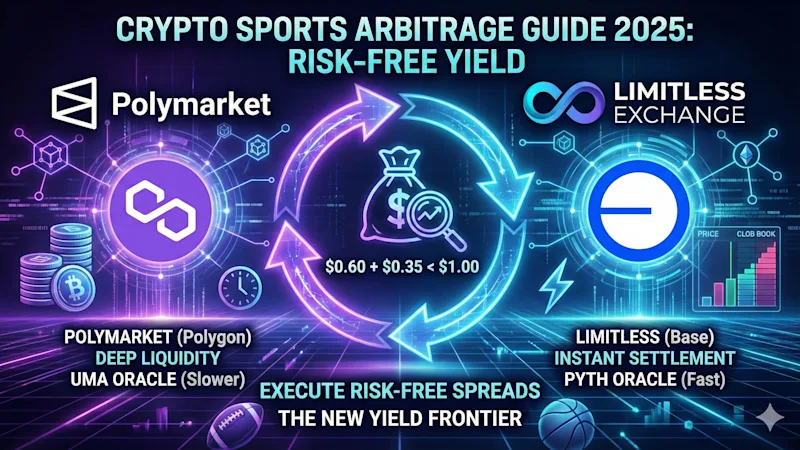
Introduction: The New Frontier of Yield
In 2025, the most profitable "yield farms" in crypto are no longer in DeFi lending protocols, but in the structural inefficiencies between prediction markets. As the sector matures, two dominant platforms have emerged on different technological stacks: Polymarket (on Polygon) and Limitless Exchange (on Base).
Because these two markets operate on different blockchains, use different settlement oracles, and serve different user bases, they frequently disagree on the probability of sports outcomes. This guide details how to execute risk-free arbitrage strategies between them, capitalizing on the "fragmented liquidity" of the modern prediction market landscape.
Why the Arbitrage Opportunity Exists
To profit, you must understand why the prices differ. Unlike centralized sportsbooks where arbitragers are banned, these are decentralized protocols where arbitrage is simply "keeping the market efficient."
1. The Blockchain Disconnect
Polymarket lives on the Polygon (PoS) sidechain.
Limitless lives on the Base L2 rollup.
Capital cannot move instantly between them. When a major injury happens in the NFL, one market may react faster than the other. The time and cost to bridge funds create a "moat" that preserves price differences for observant traders.
2. The Oracle Gap (Time Value of Money)
Polymarket uses UMA (Optimistic Oracle). Settlement usually takes 2 hours to several days after an event to allow for disputes. Your capital is locked during this time.
Limitless uses Pyth (Push Oracle). Settlement is often instantaneous (minutes after the game ends).
The Edge: Traders often demand a discount on Polymarket because of the lock-up period. Limitless prices might be higher (lower yields) because capital is freed immediately.
3. Market Structure (AMM vs. CLOB)
Polymarket uses a hybrid AMM/Orderbook model that is very deep and liquid.
Limitless uses a fully on-chain Central Limit Order Book (CLOB). Liquidity can be thinner, leading to temporary price spikes that smart money can snipe.
Technical Infrastructure Setup
Before placing a single trade, you must build a "pipeline" to move USDC efficiently.
Wallet Configuration
Use Rabby Wallet or MetaMask. You need to add both networks:
Polygon Mainnet (Token for Gas: POL)
Base Mainnet (Token for Gas: ETH)
The USDC Trap: Understand Your Assets
This is the most common mistake for beginners.
On Polymarket (Polygon): The platform largely relies on Bridged USDC (USDC.e) from Ethereum. While native USDC exists on Polygon, ensuring you are holding the correct version compatible with the Polymarket proxy contract is vital.
On Limitless (Base): The platform uses Native USDC issued by Circle on Base.
Recommended Bridges
Speed is critical. Do not use the official "native" bridges (which take 7 days or cost high gas). Use "Intent-based" bridges or Aggregators.
Across Protocol: Extremely fast (1-2 minutes) and cheap for moving USDC between L2s. Highly recommended for rebalancing.
Symbiosis: Good for swapping and bridging if you have the wrong version of USDC (e.g., USDC.e to Native USDC).
Step-by-Step Execution Strategy
Let's assume an NFL scenario: Kansas City Chiefs vs. San Francisco 49ers.
Phase 1: Screening for Divergence
You are looking for a situation where the Total Implied Probability < 100%.
Open Polymarket and Limitless side-by-side.
Find the "Moneyline" (Winner) market for the game.
Check the prices:
Polymarket: Chiefs to Win (Yes) = $0.60
Limitless: Chiefs to Lose (No) / 49ers to Win (Yes) = $0.35
The Calculation:
$$Cost = 0.60 + 0.35 = 0.95$$
Since $0.95 < $1.00$, you have a 5% risk-free spread.
Note: Ensure you check the "Tie/Draw" rules. In NFL regular season, ties happen. Ensure both markets treat ties the same way (usually "push" or void).
Phase 2: Liquidity Check (Depth)
A 5% spread is useless if you can only bet $10.
On Limitless: Check the Order Book. How much is available at $0.35? Let's say there is $500 liquidity.
On Polymarket: There is likely $50,000+ liquidity at $0.60.
Constraint: Your maximum trade size is capped by the thinner market (Limitless). You can only bet $500.
Phase 3: Execution (The "Leg-In")
Order of operations matters to avoid "slippage risk."
Leg 1 (The Thinner Market): Execute the trade on Limitless first. Buy the $500 worth of shares. Since liquidity is lower, if you wait, a bot might take it.
Leg 2 (The Deeper Market): Immediately buy the hedging position on Polymarket. Since Polymarket is highly liquid, the price is unlikely to move against you in the few seconds it takes to switch tabs.
Phase 4: Settlement and Rebalancing
The game ends. One side wins ($1.00), the other loses ($0.00).
Scenario A (Win on Limitless):
Settlement is instant via Pyth.
You have $1,000 (roughly) on Base.
Polymarket position goes to $0.
Result: All your funds are now on Base. You are unbalance.
Scenario B (Win on Polymarket):
Wait for UMA resolution (approx. 24 hours).
Redeem winnings.
Result: All your funds are now on Polygon.
Rebalancing: Use Across Protocol to move ~50% of the winnings back to the empty chain to prepare for the next opportunity.
Fee Analysis and Profit Erosion
Arbitrage margins are thin. You must account for friction.
Polymarket Fees
Trading Fee: Generally 0% for Takers (standard users). This is a massive advantage.
Cost: Only gas fees (POL), which are negligible ($0.01 - $0.05).
Limitless Exchange Fees
Trading Fee: Variable. Usually ranges from 0.03% to 3.0% depending on the market volatility and time to expiry.
Crucial Step: Before executing Phase 3, check the current fee rate on the Limitless UI. If the fee is 3%, your 5% arb margin is reduced to 2%.
Bridge Fees
Moving funds back and forth costs money.
If you make $10 profit but spend $2 on bridging fees to rebalance, your net profit is $8.
Rule of Thumb: Decentralized Sports Arb is volume-dependent. It is rarely worth it for trade sizes under $500 due to fixed gas/bridge costs.
Risk Management
Even "risk-free" trades have risks in crypto.
Smart Contract Risk: Limitless is newer than Polymarket. There is always a non-zero risk of a contract bug. Do not keep your entire net worth on the exchange smart contracts.
Oracle Failure: Extremely rare, but if Pyth and UMA resolve the game differently (e.g., one counts overtime, one doesn't), you could lose both bets. Stick to major leagues (NFL, NBA, EPL) where data is standardized and disputes are unlikely.
Geo-Blocking: Both interfaces may block users from certain jurisdictions (like the US). While the protocols are permissionless, the websites are not. Ensure you have compliant access.
Summary Checklist for the Arber
[ ] Funds Ready: 50% USDC.e on Polygon, 50% Native USDC on Base.
[ ] Gas Ready: POL for Polygon, ETH for Base.
[ ] Target Acquired: Total implied probability < 98% (leaving 2% buffer for fees).
[ ] Liquidity Verified: The thinner book can absorb your trade size.
[ ] Execution: Buy Limitless -> Buy Polymarket.
[ ] Cleanup: Redeem -> Bridge -> Repeat.



![[Web3 Native] Create Instant Link Pages with Google! Introducing "cryptolinks.space"](https://images.ctfassets.net/wv6s970ktz13/6U7eMUOuQ0NqxgADqaF3fg/b84d540edc4900ffe5aafbf5c748f334/Gemini_Generated_Image_mb6z0zmb6z0zmb6z.png?fm=webp&w=128&h=128&fit=fill&q=75)