Trust Wallet Security Alert: How the $6M Hack Happened & The Best Hardware Wallets to Secure Your Crypto in 2025
By Coinfrontier Team | Updated December 2025
The promise of cryptocurrency is self-sovereignty, but the end of 2024 brought a harsh reminder: your keys are only as safe as the device they live on.
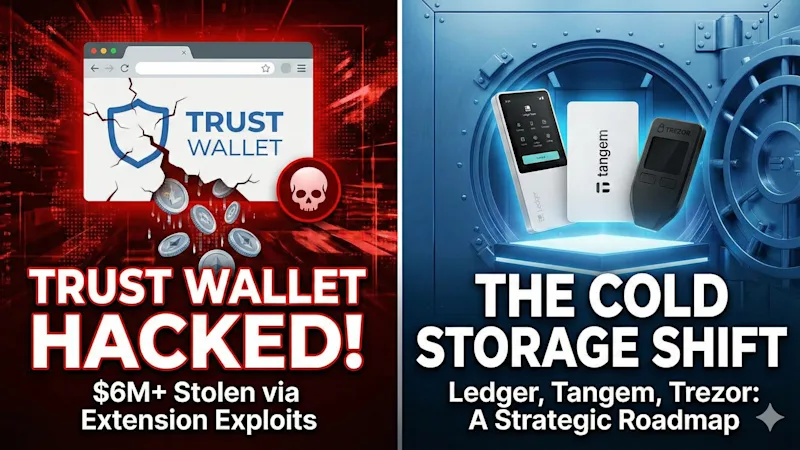
A critical vulnerability in the Trust Wallet browser extension (version 2.68) recently led to the theft of over $6 million in Bitcoin, Ethereum, and Solana. This wasn't a simple phishing email; it was a sophisticated supply-chain attack that compromised the official software itself.
If you are still using a browser extension as your primary wallet, your funds are at risk. In this guide, we break down exactly how the Trust Wallet hack happened and compare the best hardware wallet alternatives for 2025, including Ledger, Tangem, and open-source challengers like Trezor.
Anatomy of a Hack: The Trust Wallet Browser Exploit
Unlike common scams where users are tricked into revealing their seed phrases, the Trust Wallet incident was a "silent" theft.
How it Happened
Forensic analysis revealed that a malicious update was pushed to the official Trust Wallet browser extension (specifically version 2.68). This update contained a hidden script, identified as 4482.js, which acted as a "seed harvester".1
The Mechanism: The malware monitored the extension for specific actions, such as "Import Wallet" or "Create Wallet."
The Theft: As soon as a user typed their 12 or 24-word recovery phrase, the script intercepted it from the browser's temporary memory—before it could be encrypted—and sent it to a hacker-controlled server (
metrics-trustwallet[.]com).1The Result: Victims saw their wallets drained of all assets shortly after legitimate usage.
Immediate Action Required
If you used the Trust Wallet browser extension in late 2024, assume your seed phrase is compromised. Do not just delete the extension. You must create a completely new wallet on a secure device and transfer any remaining funds immediately.
The Solution: Why You Need "Cold Storage"
The Trust Wallet incident proves a fundamental truth: Web browsers are hostile environments for crypto. Extensions have broad permissions, and if the software itself is compromised, no amount of caution can save you.
The only way to guarantee safety is to separate your private keys from the internet. This is where Hardware Wallets (Cold Storage) come in.
How Hardware Wallets Protect You
Offline Keys: Your private key never leaves the physical device.
Physical Signing: Even if your computer has a virus, the transaction cannot be sent unless you physically press a button on the device.
Isolation: A malicious browser extension cannot extract your seed phrase because it simply doesn't exist on the computer.
Best Hardware Wallets of 2025: Ledger vs. Tangem vs. Trezor
Choosing the right cold wallet depends on your needs: Security, Ease of Use, or Open Source transparency. Here is our expert comparison.
1. Ledger: The Industry Standard (Best for DeFi)
Models: Ledger Nano X, Ledger Flex, Ledger Stax
Ledger is the most popular hardware wallet brand, known for its "Secure Element" chip—the same technology used in passports.
Pros:
Secure Element (EAL 6+): Provides military-grade protection against physical hacking.
Clear Signing: The new Ledger Flex and Stax feature E-Ink touchscreens that show you exactly what you are signing, protecting you from "blind signing" scams.
Huge Ecosystem: Supports thousands of coins and connects to almost every dApp.
Cons:
"Recover" Controversy: Ledger offers an optional seed recovery service that requires KYC, which some privacy advocates dislike.
Closed Source: You cannot independently verify the firmware code.
Protect your assets now: Ledger
2. Tangem: The User-Friendly Choice (Best for Beginners)
Models: Tangem Wallet (2.0)
Tangem has disrupted the market with a credit-card-shaped wallet that uses NFC to connect to your phone. It is radically simple and durable.
Pros:
Seedless Setup: The chip generates the key and clones it to backup cards. You never have to write down or hide a seed phrase, eliminating the risk of someone finding your paper backup.6
Indestructible: The card is waterproof, dustproof, and has no battery to die.
Ease of Use: Just tap the card to your phone to sign a transaction.
Cons:
Blind Signing Risk: Because the card has no screen, you must trust what your phone display shows. If your phone is compromised, malware could trick you into signing the wrong transaction (though Tangem uses software simulation to mitigate this).
No "Paper" Backup: If you lose all your cards, your funds are gone (unless you opt for the legacy seed phrase option).
Protect your assets now: Tangem
3. Trezor: The Open Source Defender (Best for Purists)
Models: Trezor Safe 3, Trezor Safe 5
Trezor created the first hardware wallet and remains the favorite for those who value transparency.
Pros:
Fully Open Source: Both hardware and software designs are public, meaning the community can audit them for backdoors.
New Security: The "Safe" series now includes a Secure Element (EAL 6+), fixing physical vulnerabilities found in older models.
Touchscreen (Safe 5): Offers a premium experience similar to Ledger but with open-source code.
Cons:
Less "Sleek": The design is functional but less "premium" feeling than the Ledger Stax or Tangem.
4. BitBox02: The Bitcoin Maximalist's Choice
Models: BitBox02 (Bitcoin-only edition)
Swiss-made and security-obsessed, BitBox02 is often cited as the safest option for pure Bitcoin storage.
Pros:
Dual-Chip Architecture: Combines open-source firmware with a secure element.
Bitcoin-Only Firmware: By removing code for other coins, it drastically reduces the "attack surface" for bugs.
SD Card Backup: Easy, encrypted backups without writing down words.
Comparison Matrix
Final Verdict: Which Wallet Should You Choose?
The Trust Wallet hack is a wake-up call. Moving your funds to cold storage is not optional—it is essential.
Choose(https://tangem.com) if you are new to crypto and want a "set it and forget it" solution that feels like using a bank card. The seedless setup prevents user error.
Choose(https://ledger.com) if you are active in DeFi, collect NFTs, or trade frequently. The screen is vital for verifying smart contract interactions securely.
Choose(https://trezor.io) or BitBox02 if you care about Open Source software and want to trust code, not a company.
Don't wait for the next hack. Secure your assets today.
Disclaimer: This article is for educational purposes only and does not constitute financial advice. Always do your own research before securing your digital assets.
🎉 Thanks for Reading!
Claim your reward for completing this article.



![[Web3 Native] Create Instant Link Pages with Google! Introducing "cryptolinks.space"](https://images.ctfassets.net/wv6s970ktz13/6U7eMUOuQ0NqxgADqaF3fg/b84d540edc4900ffe5aafbf5c748f334/Gemini_Generated_Image_mb6z0zmb6z0zmb6z.png?fm=webp&w=128&h=128&fit=fill&q=75)